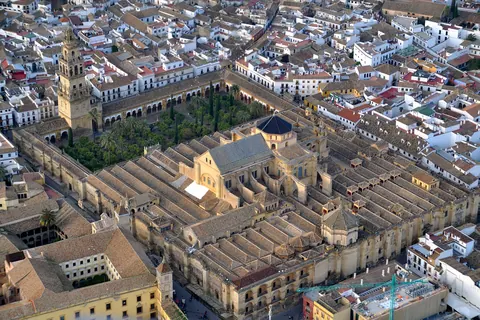
The Mosque–Cathedral of Córdoba is the cathedral of the Roman Catholic Diocese of Córdoba in the Spanish region of Andalusia. Officially called the Cathedral of Our Lady of the Assumption, it is dedicated to the Assumption of Mary. Due to its status as a former mosque, it is also known as the Mezquita and, in a historical sense, as the Great Mosque of Córdoba.
According to traditional accounts, a Visigothic church, the Catholic Christian Basilica of Vincent of Saragossa, originally stood on the site of the current Mosque-Cathedral, although this has been a matter of scholarly debate. The Great Mosque was constructed in 785 on the orders of Abd al-Rahman I, founder of the Islamic Emirate of Córdoba. It was expanded multiple times afterwards under Abd al-Rahman’s successors up to the late 10th century. Among the most notable additions, Abd al-Rahman III added a minaret, and his son al-Hakam II added a richly decorated new mihrab and maqsurah section. The mosque was converted to a cathedral in 1236 when Córdoba was captured by the Christian forces of Castile during the Reconquista. The structure itself underwent only minor modifications until a major building project in the 16th century inserted a new Renaissance cathedral nave and transept into the center of the building. The former minaret, which had been converted to a bell tower, was also significantly remodelled around this time. Starting in the 19th century, modern restorations have, in turn, led to the recovery and study of some of the building’s Islamic-era elements. Today, the building continues to serve as the city’s cathedral, and Mass is celebrated there daily.
The mosque structure is an important monument in the history of Islamic architecture and was highly influential on the subsequent "Moorish" architecture of the western Mediterranean regions of the Muslim world. It is also one of Spain’s major historic monuments and tourist attractions, as well as a UNESCO World Heritage Site since 1984.
Sources
- Wikipédia (fr) : Mosquée-cathédrale de Cordoue
- Wikipedia (en): Mosque–Cathedral of Córdoba
- Wikidata: Q33200
- Official website
Text: introduction of the Wikipedia article Mosque–Cathedral of Córdoba, under the CC BY-SA 4.0 licence (authors: article history). Facts: Wikidata (CC0). Coordinates: Wikidata, map background © OpenStreetMap contributors.